
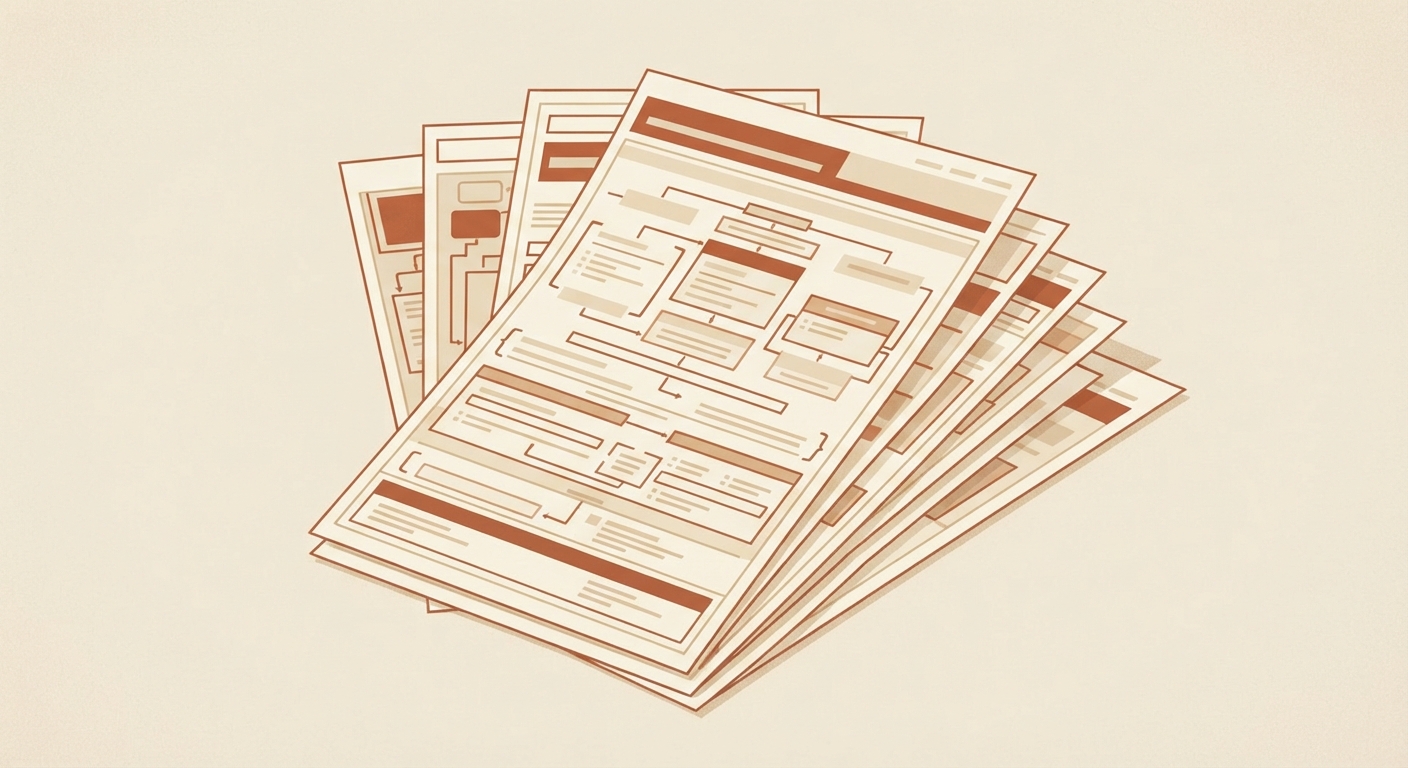
An auto insurance policy is not a single document but a small stack of them, bound together and meant to be read in a particular order. Policyholders who only glance at the declarations page, or who skim the first few pages of the policy booklet and stop, often miss the parts that actually determine whether and how much a claim will be paid. This entry walks through the structure in the sequence it is designed to be read: the summary page, the coverage parts, the exclusions attached to those parts, and the endorsements that sit on top of everything else.
The Declarations Page as the Summary Layer
The declarations page – often shortened to “dec page” in agent correspondence and claims notes – is the cover sheet of the policy. It is usually one to three pages long and sits at the very front of the packet. Its job is to summarize, not to explain. It lists:
- The named insured and any listed drivers
- The vehicles covered, identified by VIN, year, make, and model
- The policy period (start and end dates)
- The coverages the policyholder purchased, each paired with a dollar limit
- The deductible amount for coverages that carry one
- The premium for each coverage line and the total premium
Because the declarations page is generated from the insurer’s rating system, it reflects whatever combination of coverages and limits the policyholder selected or was assigned at underwriting. Two policyholders with the same insurer and the same base policy form can have declarations pages that look entirely different, because the selections differ. This is why the declarations page is a summary layer rather than a source of terms: it tells the reader what was bought, not what any of it means. The definitions, conditions, and limitations live in the coverage parts and endorsements that follow.
A practical habit worth noting: whenever a policyholder wants to check “do I have this coverage” or “what’s my limit,” the declarations page is the correct place to look first. Whenever the question is “what exactly does this coverage do” or “when does it not apply,” the declarations page will not answer it – the coverage part will.
Coverage Parts and What Each One Insures
After the declarations page, the policy booklet is organized into coverage parts, sometimes called coverage forms or insuring agreements. Each part is a self-contained module: it has its own insuring agreement (the sentence or paragraph stating what the insurer promises to do), its own definitions, its own exclusions, and sometimes its own conditions. A standard personal auto policy typically includes some arrangement of the following parts, though the exact naming and grouping vary by insurer and by state form.
Liability Coverage
This part responds when the policyholder is legally responsible for injuring another person or damaging another person’s property in an auto accident. It typically splits into bodily injury liability and property damage liability, each with its own limit shown on the declarations page. Liability coverage pays on behalf of the insured, meaning the insurer defends and pays claims brought by others – it does not pay the policyholder’s own injuries or repair the policyholder’s own vehicle.
Collision Coverage
Collision coverage pays for damage to the policyholder’s own insured vehicle when it collides with another vehicle or object, or overturns, generally regardless of who caused the accident. This coverage is subject to the deductible listed on the declarations page and is valued against the vehicle’s actual condition at the time of loss, not its original purchase price.
Comprehensive (Other-Than-Collision) Coverage
Comprehensive coverage – sometimes labeled “other than collision” in the policy form itself – pays for damage to the insured vehicle from causes other than a collision with another vehicle or object. Typical triggering events include theft, fire, falling objects, glass breakage, and contact with animals. Like collision, it is subject to a deductible and is valued at the vehicle’s condition at the time of loss.
Medical Payments or Personal Injury Protection
Depending on the state and the policy form, this part covers medical expenses for the policyholder and passengers after an accident, without regard to fault. Personal injury protection forms, where available, may also cover a broader set of losses such as lost income, and they interact with liability coverage and with health insurance in ways that vary by state. This entry does not address which coverage pays first in a given state; that sequencing is a matter of state-specific rules and policy language that should be checked in the specific coverage part.
Uninsured and Underinsured Motorist Coverage
This part responds when the policyholder or a passenger is injured by a driver who has no liability insurance, or whose liability limits are insufficient to cover the loss. It functions as a stand-in for the at-fault driver’s missing or inadequate coverage, subject to its own limit and its own definitions of what counts as “uninsured” or “underinsured” for purposes of the policy.
Other Common Parts
Many policies also include a towing and labor (roadside assistance) part, a rental reimbursement or transportation expense part, and a general conditions section covering matters such as how to report a claim, cancellation and renewal terms, and the insurer’s rights when multiple policies might apply to the same loss. These are structured the same way as the larger coverage parts: an insuring agreement, definitions, and limits.
Reading a coverage part means reading its insuring agreement first, since that sentence sets the outer boundary of what the coverage does at all. Everything else in that part – definitions, exclusions, limits – narrows or clarifies that boundary. A coverage part never grants more than its insuring agreement states, no matter what a definition elsewhere in the policy might seem to imply.
Exclusions as Carve-Outs from the Coverage Parts
Each coverage part contains its own exclusions section, listing circumstances or uses for which that particular coverage does not apply. Exclusions are carve-outs, not separate rules: they only make sense in relation to the insuring agreement they modify. An exclusion in the liability part has no bearing on the comprehensive part, and vice versa, unless the policy explicitly cross-references it.
Common categories of exclusion found across standard forms include:
- Use-based exclusions – for example, use of the vehicle for delivery services, ridesharing, or other commercial purposes not disclosed at underwriting
- Vehicle-based exclusions – for example, vehicles not listed on the declarations page, or vehicles used off-road in ways inconsistent with their rated use
- Driver-based exclusions – for example, a named exclusion for a specific individual who is not permitted to drive the insured vehicle under any coverage
- Intentional-act exclusions – damage or injury caused deliberately by an insured person
- War, nuclear, and similarly catastrophic exclusions – standard boilerplate carried over from broader insurance industry practice
Exclusions are worth reading in full rather than skimmed, because they are typically written in dense, cross-referencing language and because they define the edge of coverage more precisely than the insuring agreement does. A policyholder trying to understand whether a specific situation is covered – a borrowed vehicle, a part-time delivery job, a car modified for racing – will usually find the answer in the exclusions section of the relevant coverage part rather than in the insuring agreement itself.
Endorsements and How They Modify What Came Before
Endorsements, also called riders in some contexts, are separate forms attached to the policy that add, remove, or change language in the declarations page or the coverage parts. They are usually listed by form number on the declarations page and printed as short standalone pages toward the back of the policy packet, or issued separately at renewal.
Endorsements exist because the base coverage forms are standardized – often drawn from templates used across many insurers with a particular state’s approved language – while individual policyholders need adjustments for their specific vehicle, household, or state requirements. Rather than rewriting the entire coverage part, the insurer attaches an endorsement that overrides a specific piece of it.
Common types of endorsement include:
- Named non-owner endorsements, extending liability coverage to a person who does not own a vehicle but drives one regularly
- Rideshare or transportation network company endorsements, restoring or modifying personal auto coverage during periods when the vehicle is being used for a rideshare platform
- Custom equipment or accessory endorsements, extending comprehensive and collision coverage to aftermarket parts not included in the vehicle’s standard valuation
- Loan or lease gap endorsements, addressing the difference between a vehicle’s actual cash value and the amount owed on a loan or lease after a total loss
- Exclusion endorsements, formally removing a named driver from all coverage on the policy
- State-mandated endorsements, required by a particular state’s insurance regulator and attached automatically to policies issued in that state
Endorsements sit at the top of the reading order in terms of authority: where an endorsement conflicts with the base coverage part or the declarations page, the endorsement’s language generally controls, because it was issued more recently and specifically to modify the standard form. Most policies include a statement to this effect in their general conditions, sometimes phrased as a rule about which provision governs in case of conflict.
Reading the Policy in Order
Put together, the intended reading sequence runs: declarations page for what was bought and at what limit; coverage parts for what each purchased coverage actually promises; exclusions within each part for what that promise does not extend to; and endorsements, checked last, for anything that has been added, removed, or altered since the base form was printed. A question about a specific situation – a claim, a new driver, a vehicle modification – is best answered by identifying which coverage part governs it, then checking that part’s exclusions, and finally checking the endorsement list on the declarations page for anything that overrides the standard language. Skipping any one of these four layers is the most common reason a policyholder’s understanding of their own coverage turns out to be incomplete.
